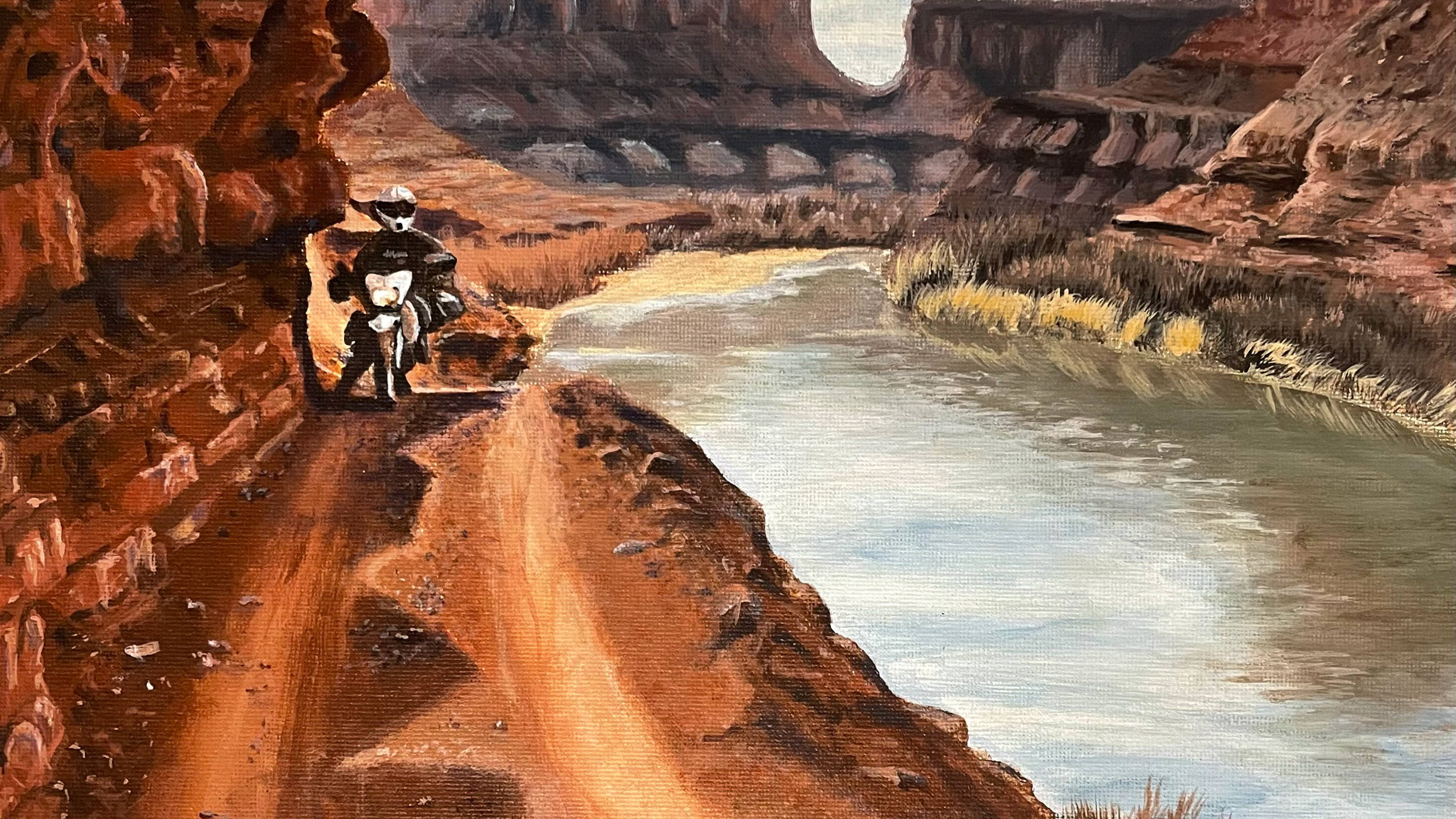
Memo Responses to Calvino's Six Memos for the Next Millennium
Memo Response to Calvino's Six Memos for the Next Millennium
Multiplicity
Reyn Kiesel
ART 4900: WSU Individual Study
Professor Matthew Choberka
April 20, 2026
I made my piece “Linear Entanglement" after reading Calvino's memo about Multiplicity, which is his 5th memo in his book Six Memos for the Next Millennium. While working on this piece, I was very focused on how Calvino explores the interconnection and endless branching of each story, which influenced my decision to create overlapping and intertwined forms and to imply connections among figures in the composition.
When making this piece, I was very focused on Calvino's literary connections to Carlo Emilio Gadda's work, specifically his detective novel That Awful Mess on the Via Merulana, in which Gadda describes “The Knot,” which led me to consider complexity and unresolved entanglements in my piece. I chose to represent reality as a straight line of figures but also as an intertwined set of possibilities, directly inspired by the way both Calvino and Gadda approach narrative complexity. I was also heavily inspired by Calvino's network of possibilities when making my work.
The Knot, in which I will explain the complexity of reality, is how I designed the setup of my piece. Visually, each figure is rendered as a distinct, changing figure that may or may not be the same person, their forms intentionally incomplete or disjointed to reinforce the idea of partial stories, a memory, or perspectives. The placement of my figures follows a curving, linear pattern across the composition, imitating the movement of a line that crosses over itself and multiplies into offshoots, rather than a single path. Each figure illustrates a point in the line of reality, marking moments in the linear aspect of time from end to beginning.
The background, where the figures intentionally seem to float, is dense and layered with intersecting lines and blocks of color that tangle and overlap, representing the intricacy and confusion of the Knot itself. I used a mix of cool tones, with a complementary yellow that leaks throughout the piece, to visualize the
noise of infinite possibility and the unforeseeable variables that shape each point: people, decisions, time, environment, relationships, and more. When putting together these variables from Cavino's writings and the arrangements of my own piece, I intended to make visible the impossibility of fully unraveling fate or explaining the butterfly effect, with a definable "encyclopedia" more like an untied, indescribable knot of reality.
I also really liked that every insignificant thing in the universe affects a person's story. Everything is connected to the rope of reality. The connection is the key to my piece. It is to visually narrate the story of each connection across space and time. There is so much possibility in the universe, making our decision-making a network of multiplicity. To conclude my ideas on my work, I can say that I was heavily inspired by both Calvino and Gadda’s emphasis on complexity and interconnection.
I find myself simultaneously agreeing with and pushing their perspectives in my own work. I agree that life is full of infinite, unpredictable threads and that every action ripples outward, sometimes in ways we can never foresee. In my own work, I also want to suggest that even within this entanglement, individuals have the capacity to trace their particular path, making deliberate decisions that shape their stories. So, while my piece adopts the encapsulation of unresolved knots and countless possibilities, it also holds onto a hope that some connections can be recognized and made meaningful through our awareness and conscious effort.
Bibliography
Calvino, Italo. Six Memos for the Next Millennium. Cambridge, MA: Harvard University Press, 1988.
Memo Response to Calvino's Six Memos for the Next Millennium
Quickness
Reyn Kiesel
ART 4900: WSU Individual Study
Professor Matthew Choberka
February 10, 2026
I would like to first open this response to the memo with the quote from Calvino's Six Memos for the Next Millennium in the lecture. This quote was my favorite quote from the memo and inspired me the most. “From my youth on, my personal motto has been the old Latin tag, Festina lente, hurry slowly.” If I were to put the memo into simple words, it would be “Make haste slowly”.
Time is wonderful and dangerous. Through my art, I've never sat down to think about the time surrounding it. I've always glazed over the concept in my mind. “How long will this take me?” “ Can I get this done in 3 hours?” “What time period do I want this placed in?” Simple questions and simple thoughts that didn't feel wrong. When painting Fleeting Recollection, my oil-on-board painting that inspired my Clavinos quickness memo, I decided to approach my ideas of time in a different way. I wouldn't be just thinking of time as an interval but as a being, a memory, as motion, as imagination. I would not be limiting myself to numerical understanding.
“I have always aimed at the image and the motion that arises naturally from the image, while still being aware that one cannot speak of a literary result until this stream of imagination has been turned into words.” Transforming images into ideas is the basis of painting itself. Calvino is talking about making writings based on imaginative images in the mind. While reading, I converted this idea into painting and thought about fleeting memories.
When writing something, it is easy to write down what you want to remember and put it off until another day or another year, but as an artist, I have found that I have forgotten what I was once inspired by. In practice, I could do a small, simple drawing to capture the fleeting inspiration, but in reality, that is impractical when ideas are constant. However, I started to reconsider this constraint, wondering, 'How else might I honor constant ideas without pressuring perfection (hurrying too fast)?' This curiosity led me to explore new possibilities for capturing inspiration on the fly and sparked inventive, time-sensitive methods for documenting my creative flashes. In Fleeting Recollection, I decided to depict the idea of a fleeting moment that you will never get back again because you were not quick enough to grasp it into reality, making it unreal altogether. The painting features a gradient of soft yellows, suggesting the dissolution of time into memory, while delicate brushstrokes of grass surround the central figures, the rabbits, making you fade into a sense of deja vu. This evokes a sense of motion and elusiveness, capturing the essence of a memory slipping away just beyond reach.
As said in the memo, time is a straight line, point-to-point, but can diverge into squiggly lines of digression. A moment of wandering, of confusion, a fleeting memory. While these moments can lead to great destinations, they ultimately converge on the same endpoint. "... I am not devoted to aimless wandering; I'd rather say that I prefer to entrust myself to the straight line, in the hope that the line will continue into infinity, making me unreachable. I prefer to calculate my flight trajectory in detail, expecting to be able to launch myself like an arrow and disappear over the horizon. Or else, if many obstacles bar my way, to calculate the series of rectilinear segments that will lead me out of the labyrinth as quickly as possible." It is crucial to escape quickly from the tangle. Such entanglements slow you down and confuse you. They force you to watch your feet to avoid tripping over obstacles, which can lead to disorientation. However, it would be more efficient and quicker to slow down, observe the path ahead, and learn from your surroundings.
Calvino's memo, quickness, has made me think about success. How rapid my imagination needs to be to get that flash of inspiration, and how we must slow down and be patient to reach our goal efficiently. Moving forward, I am committed to embracing the balance between urgency and patience, allowing 'hurry slowly' to guide my creative process. I invite you, dear reader, to reflect on your own pace: how might the wisdom of 'Festina lente' transform the way you approach your pursuits?
Bibliography
Calvino, Italo. Six Memos for the Next Millennium. Cambridge, MA: Harvard University Press, 1988.
Memo Response from Calvino's Six Memos for the Next Millennium
Exactitude
Reyn Kiesel
ART 4900: WSU Individual Study
Professor Matthew Choberka
March 10, 2026
Exploring Calvino’s concept of 'exactitude' pushed me to challenge my usual creative habits and discover the impact of intentional planning on my art. When working on a piece, I tend not to plan very far in advance. I'm spontaneous, uncoordinated, and tend to fall into my ADD habits of being scattered and impulsive. As an artist, this tends to work out for me. I have windows of inspiration, and I can quickly and efficiently find ideas. While reading Calvino's third memo, I jumped into his idea of exactitude, which made me think about his process for making a piece stand out even more. So I went against what was normal to me. I sat down and really planned out my piece, her bridge between perfection.
Calvino’s comparison of crystals inspired me. As I adapted his crystal ideas into flowers, I imagined cool, translucent petals edged in light, each one with a sharp clarity that caught the eye like facets of quartz. I can nearly feel the transformation of a mineral geometry as it dissolves into delicate, living forms. This bridge between the mineral world and living matter wasn't simply a concept, but something that could almost feel tactile, as if I could trace with my finger on the clear surface, which gave way to softness and color. This idea then inspired me to bridge the beauty of a flower and the complexity of a figure within my own work.
Calvino puts this idea beautifully in his own words: “The crystal, with its precise faceting and its ability to refract light, is the model of perfection that I have consistently cherished as an emblem, and this predilection has become even more meaningful since we have learned that certain properties of the birth and growth of crystals resemble those of the most rudimentary biological creatures, forming a kind of connection between the mineral world and living matter.”
I chose the flowers because of the crystals, and I chose the human figure because I liked that Calvino mentioned the Egyptians' perfect proportions. Because of this, I chose a different technique for painting my figure. I used a grid to align the figure as closely as possible with my reference picture. Using this sketching style reminded me of how useful this tool is. It helped me focus on the small details and made it really fun to focus on the features of the face I normally don't put as much effort into, because I would be putting a lot of my energy into repainting the face, which wouldn't always look right. What surprised me most was how slightly shifting the position of one eye could suddenly bring the whole face into a natural balance. I realized that before, my spontaneous approach to painting usually made me overlook how even one subtle misalignment could throw off the whole expression. With the grid, I started noticing individual proportions—the contour of a cheek, the detail of specific pettles—in a way I wouldn't focus much on without the grid. It was a kind of discovery that changed how I saw the entire process, and it made me want to keep using this method. Planning my underpainting beforehand with the grid really helped with the exactitude.
Before applying Calvino's principles to my own process, I revisited his concise definition of exactitude. Calvino starts his lesson with a simple definition:
“To my mind exactitude means three things above all: (1) a well-defined and well-calculated plan for the work in question; (2) an evocation of clear, incisive, memorable visual images; in Italian we have an adjective that doesn't exist in English, "icastico," from the Greek εἰκαστικός (3) a language as precise as possible both in choice of words and in expression of the subtleties of thought and imagination”
This was the first outline I used to base my piece. I hoped to follow his definition as “steps”. I essentially overanalyzed the process, which I think is the perfect way to approach Exactitude. First, I had my plan for the crystal idea I explained above. Then I entered my painting process, making the image readable. Finally, I gave myself more time than usual to come back to the painting with a clear mind.
When I returned to the painting after a pause, I instantly detected a subtle imbalance in the arrangement of the flowers around the figure's face. What struck me at that quiet moment was how a slight adjustment to the spacing transformed the entire composition, bringing a new sense of harmony and focus. This single insight made me realize that taking a step back and giving myself permission to reflect can reveal details I might otherwise miss, and it is in that act of deliberate pause that exactitude truly takes shape.
Overall, this project showed me that exactitude is more than just detail—it is a thoughtful, intentional, and planned approach to creation, as Calvino describes. Grasping this process has deepened my approach as an artist, helping me link inspiration and intention. Going forward, I plan to integrate this feeling of meaning into every piece, recognizing that exactitude is a continuous voyage that continually enriches my creative work.
Reyn Kiesel, Her Bridge Between Perfection, 2026, Oil on wood board.
Bibliography
Calvino, Italo. Six Memos for the Next Millennium. Cambridge, MA: Harvard University Press, 1988.
Memo Response to Calvino's Six Memos for the Next Millennium
Visibility
Reyn Kiesel
ART 4900: WSU Individual Study
Professor Matthew Choberka
March 24, 2026
Through reflection, I have found that I am a better artist when I try not to box myself in, which is exactly what I did with my painting, Daydream. After reading Italo Calvino's Memo, Visibility, from Six Memos for the Next Millennium, I wanted to create something that could represent total imagination. This consisted of no references, no limits, and total possibility. But it was hard, much more difficult than the presumed infinite possibilities could be. I thought to be with a doomed white canvas in the face of my own possibility of creation.
I had no notion of where to begin. It's not like I didn't conjure ideas, but the daunting feeling of not creating something that could live up to my imagination hit me. My feeling of creating something that could represent the fantastical images behind my eyes was seizing my act of creation. Then it struck me that I was doing exactly what Calvino feared that contemporary artists would do; I didn't welcome the rain. “I will start out this evening with an assertion: fantasy is a place where it rains,” Calvino. I was, quite frankly, boxing myself in and putting a “roof” over my inventiveness, so that my own human touches, my vulnerability, my true imagination and memory could not rain on my own fantasy. I found this Ironic because I knew this; I just read about it, but I was so caught up in what I was going to make that I forgot to have a moment with myself, my memories.
While painting, I regularly reflected on Calvino’s paraphrasing of Dante Alighieri, Purgatorio: “O imagination, you who have the power to impose yourself on our faculties and our wills, stealing us away from the outer world and carrying us off into an inner one, so that even if a thousand trumpets were to sound we would not hear them, what is the source of the visual messages that you receive, if they are not formed from sensations deposited in the memory?” Was it the divine planting images in my head to create what they foresaw? No, I am not a believer in the gods. Rather, I considered the influence of media, a significant factor for contemporary artists. We inspire each other within a vast social framework. While this plethora of information may hinder imagination due to its sheer volume, it also offers resources that can improve creativity. In the current era, the constant influx of images makes it difficult to discern what actually shapes one’s creative imagination. Unlike the past, when a single artwork could produce a lasting impression, today’s artists encounter thousands of images daily. This raises the question of whether such exposure improves or diminishes artistic ability. I remain uncertain, as I have never experienced a world without pervasive mass media.
Ultimately, I succeeded in creating what I intended. I invested my creativity into the painting, producing a work that represents a portion of my imagination. However, when I critically reflect on Calvino’s idea of “rain,” I recognize that while I allowed some spontaneity and vulnerability, I still maintained a certain level of control that prevented absolute openness to imagination and memory. My painting emerged from personal memories and impulses, but at times I wavered in fully letting go and embracing the uncertain character of imagination that Calvino describes. I am unsure whether I fully achieved the state of true perceptibility described by Calvino. I do know, however, that I understand the significance of visibility, image interpretation, and self-understanding.
Bibliography
Calvino, Italo. Six Memos for the Next Millennium. Cambridge, MA: Harvard University Press, 1988.
Reyn Kiesel
January 20th, 2026
Memo Response from Calvino's Six Memos for the Next Millennium
Lightness
In Calvino's memo, Lightness, the author presents lightness as a literary theme that underscores the contrast between the deep intensity of life and the pursuit of a more refined, graceful experience. If I were to describe lightness in one word after reading this memo, it would be ethereal, encapsulating both literary and existential aspirations for transcendence.
To go into specifics first, there are a lot of people who highly influence the understanding of lightness. Kafka, Leopardi, Lucretius, and Newton contributed to this concept. These men are who I remember the most when reading, so they are who I'm going to talk about. They all had a similar quest for lightness as all of us do in the face of our inevitable lives and burdens. To me, I categorized these people as the main shapers of lightness. Kafka and Leopardi wrote literature that explored the themes of lightness, while Lucretius and Newton had a more scientific approach to the contribution of the thoughts of lightness. Or, in other words (specifically in my words that helped me understand), there are two types of understanding: the literal scientific comprehension and the philosophical comprehension. They draw contributions to the apprehension of the anthropological understanding of the need and desire for lightness. These connections helped me put together my work of art, an oil on canvas painting, which I will later explain.
In this reading, I found lots of metaphors in regard to lightness, like dark and light, yin and yang, etc. But there was one I liked in particular that I thought was interesting: Dante and Cavalcanti’s writings with their heavy and weightless language. Dante wrote in a more precise framework about beauty and weight, where he described a structured universe where everything and everyone has their place, while Cavalcanti was more abstract and ethereal in his writings, focusing on emotion, love, and existence. I thought it was really interesting that if you put aside their works of writings of lightness, Dante and Cavalcanti are lightness and heaviness themselves as literary writers. This made me think of how I can be light as a creator when making my piece. I tried to be in the right mindset when painting. There were some things I did to implement this technique, like making sure I was not in a negative mood at all, and creating a space that was airy and comforting when creating art.
To carry on with metaphors, I was particularly fond of the section on Shakespeare's characters like Mercutio, who is lightness themself. Shakespeare writes in an imaginary language that paints a playful picture of the landscape of lightness. I used this as my inspiration for my painting. I wanted to capture the mind of Shakespeare's playful verbal texture. Through my medium, the goal was to make each of my two characters' emotions and scenery feel and appear weightless. I was not subtle with my intentions, like the works of Henry James, but bold and intentional, like Calcalcanti Vaulting over tombstones. My piece plays with melancholy and humor, as explained in the memo, where the subtle reflection of lightness is shown through irony, as Shakespeare did with his characters.
This is my reflection on the memo from Calvino's Six Memos for the Next Millennium and an interpretation of my own outlook on lightness. Through my painting, I feel as if I was able to encapsulate my own definition of my own psychological lightness and the literal lightness of the piece itself, and I will continue to use it, as I have found it to be successful and informative.
References
Calvino, Italo. 1988. “Lightness.” In Six Memos for the Next Millennium, translated by Patrick Creagh, 3–29. Cambridge, MA: Harvard University Press.